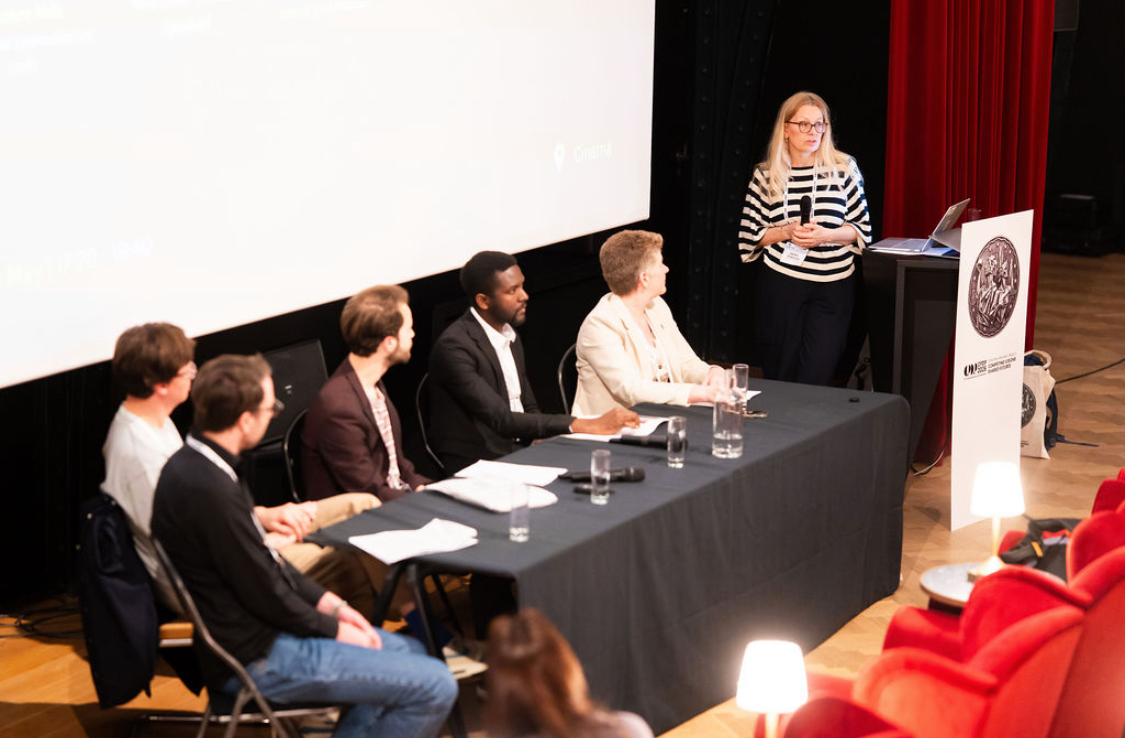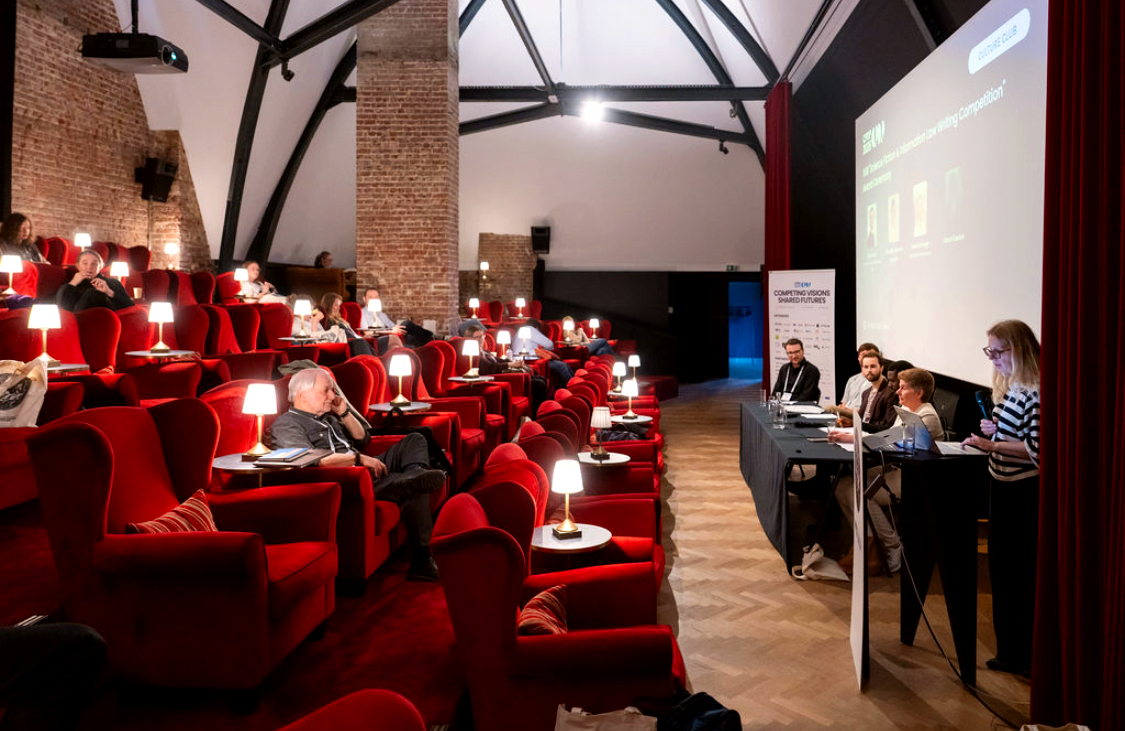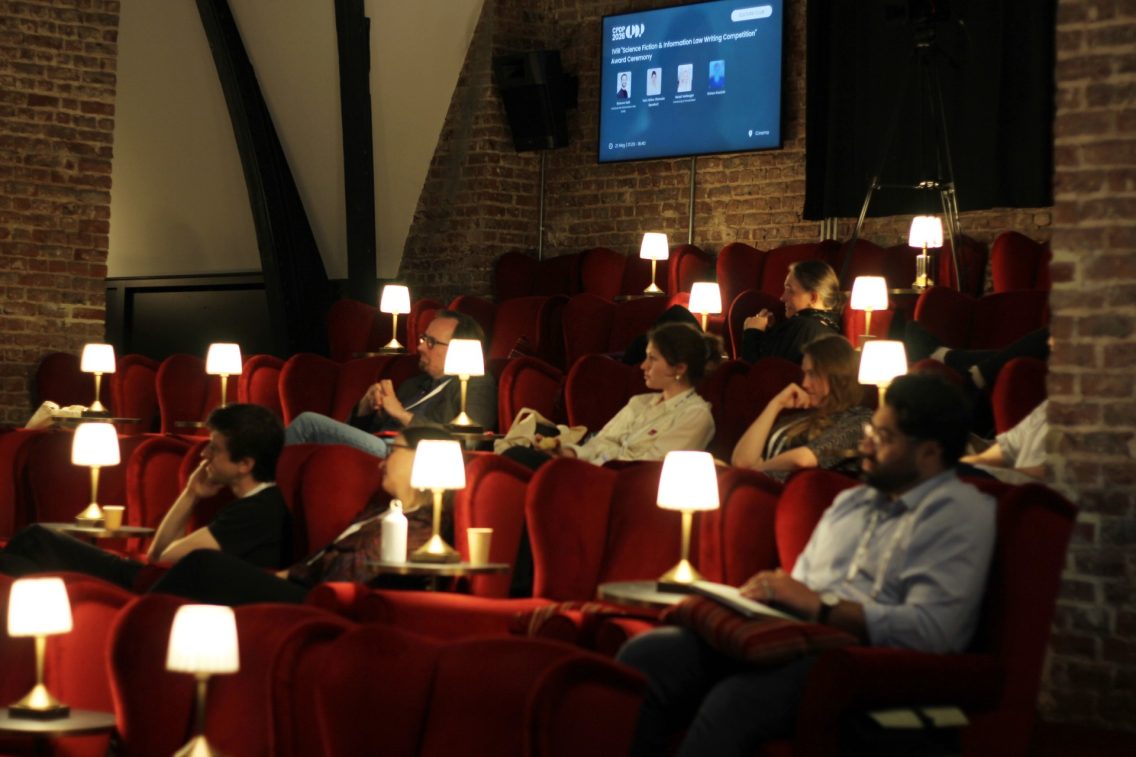
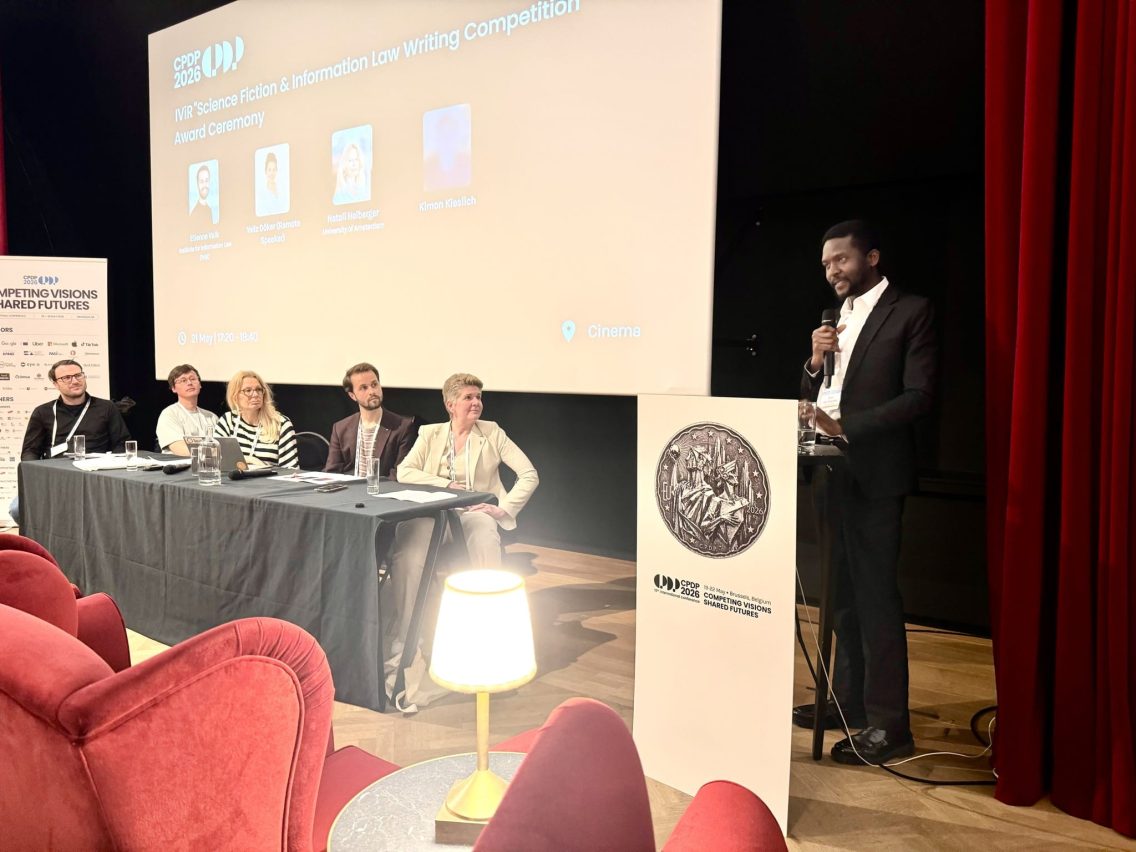
The Award Ceremony for the 4th edition of the IViR “Science Fiction & Information Law” Writing Competition was held on Thursday, 21 May, at CPDP in Brussels. A wonderful occasion to explore this edition’s theme, “The Technologised Future of Truth”, and honour the most valuable contributions.
Narratives and rules – they are both powerful tools in imagining and shaping the future. Especially for rules, like information law, that deal with technologies that are literally the stuff science fiction stories are made from. Rules do not work without ideas of how a future society should be and behave, and society does not function without rules or technology.
This edition, there was an extraordinarily high level of submissions, all tackling this delicate subject matter in many different ways. Each of the seven short-listed stories (which can be read here) could have been an award-winning story, which made picking just one winner virtually impossible. Yet three stories especially were outstanding in their own right…and so, for each of those stories, we introduced a winning category:
Most Thought-Provoking Story
I Will Tell You That I Love You
by Seun Lari-Williams
“A science fiction story used to think through legal arguments and implications but also the triumph of inhumane innovation and digital colonialism, including of the mind.” That is how one of the jury members described this very original story. It touches upon many information law topics and themes in a natural, seamless way. To name a few: intellectual property, unfair contracting and fair remuneration for artists, which clearly ties in with the author’s research into copyright dispute resolution, the regulation of emerging technologies, more specifically mind datafying technologies, and their implications for consent and fundamental rights.
The story explicitly discusses different interpretations of regulations – even including a comparative perspective between Africa, more specifically Nigeria, and the EU. “The treatment of comparative law was wonderful,” one jury member noted. “Very clever, with a good legal analysis”, said another.
This story stood out for its substance. An urgent substance, delivered from the maybe not so far future in superb packaging. We were privileged to receive it, and to be able to engage with it.
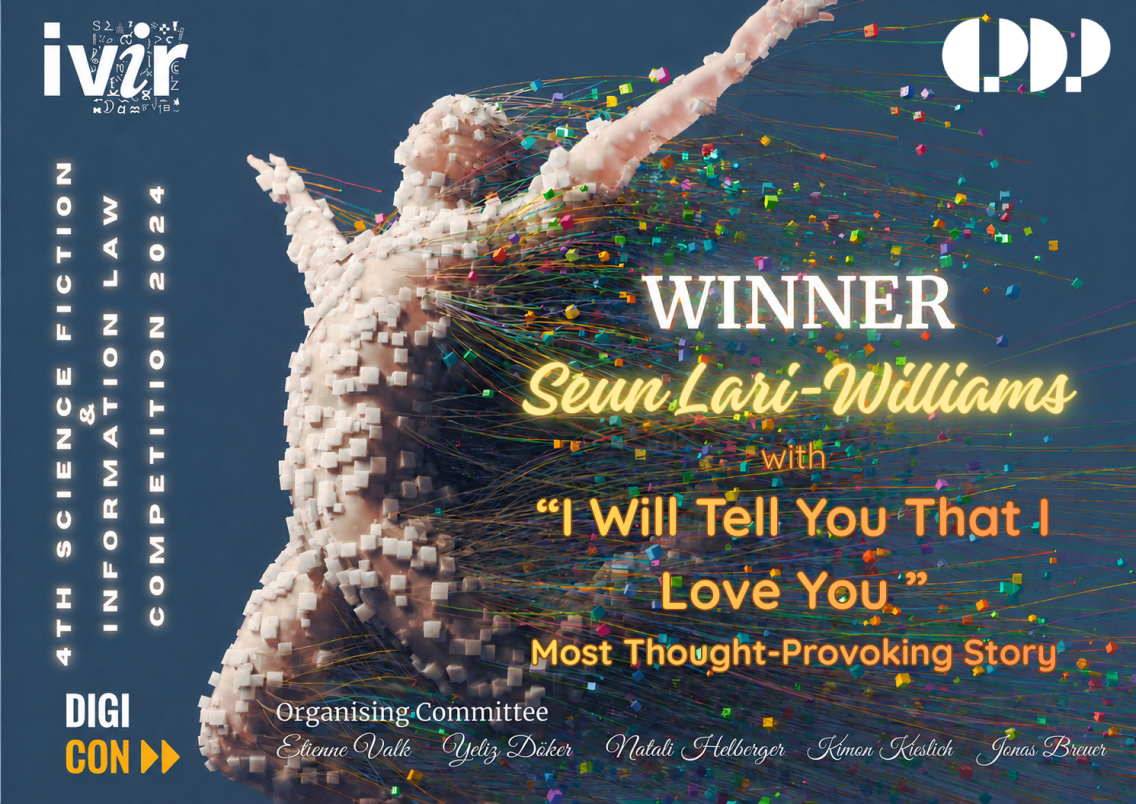
That is why the external jury was unanimous in rewarding it with “The Most Thought-Provoking Story” award. Seun Lari-Williams enriched the Award Ceremony with his inspirational presentation, guiding us through the making of his story. From the story’s poem that set the creative process in motion, to his distinctive habit of thinking in sounds and music rather than in words. He also highlighted his need in academic work of thinking legal ideas to their extremes, and the power (science) fiction has to facilitate that process.
Most Immersive Story
The Semantic Corridor
by Caroline De Cock
Writing a gripping dark, desperate and dystopian idea of the future that gets to you is impressive. But writing a story that is dystopian, dark and desperate that makes you laugh? That is an entirely different level of mastery of the written word and connecting to the reader. All the members of the committee agreed that The Semantic Corridor is not only a very clever and engaging story, but that it is funny, sharp and a joy to read.
This is a story about divergent AI governance approaches that are firmly coded into LLMs, where our last hope for world peace are professional translators of meaning. The committee praised how the story cleverly reminds us how critical the role of language is in our society, and that language is power, political power. It takes a number of clichés and generalisations about three different approaches to governance to their extreme.
Yet it remains contained, and in an understated tone allows for a detailed premise and unfolding of a story that is satirical, yet uncomfortably close to our truth. And maybe there is a deeper lesson to take from the way Caroline made her way through the Semantic Corridor – while the synthetic Trump and Swift sticks divide us, it is humour that binds us and reminds us that we are not an LLM.
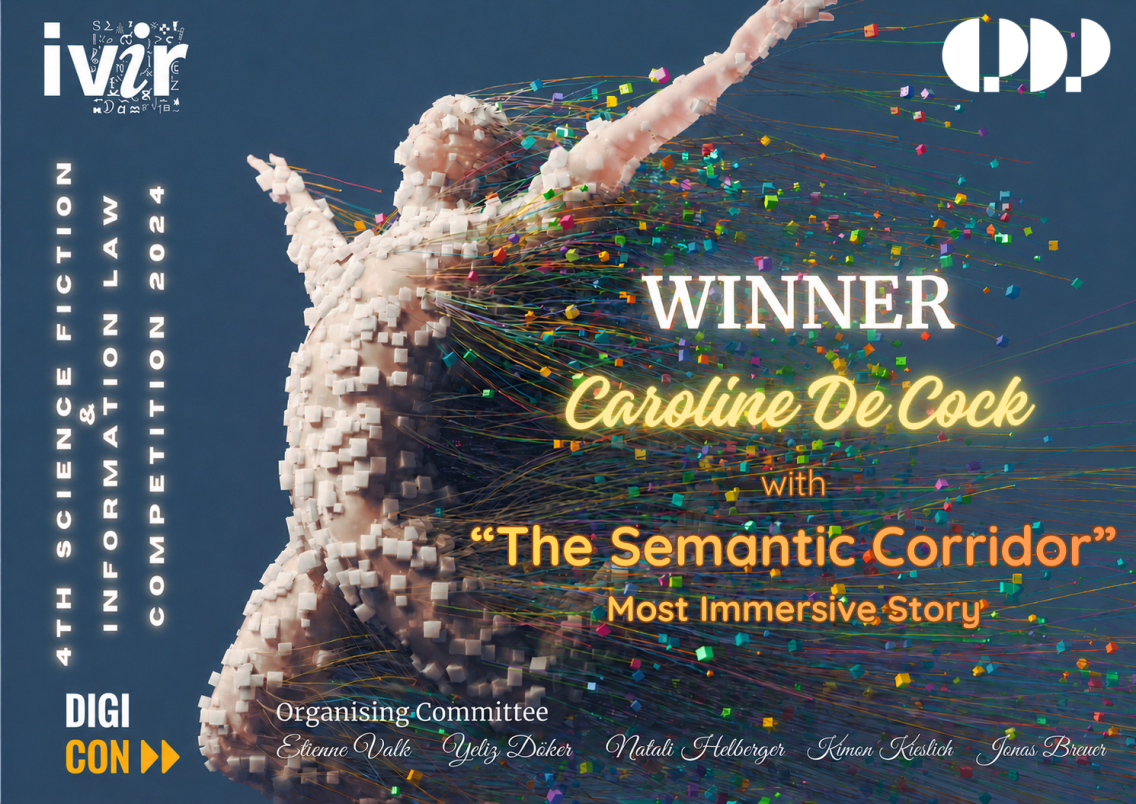
Moving between an archaic, asbestos-filled Europe and an ultra-optimised America, the jury agreed: from all the stories they have read, this is the most immersive one. In celebration of the “Most Immersive Story” award, the head of DigiCon’s Sci-Fi Section Yeliz Döker turned the story into a virtual gallery, here. 1
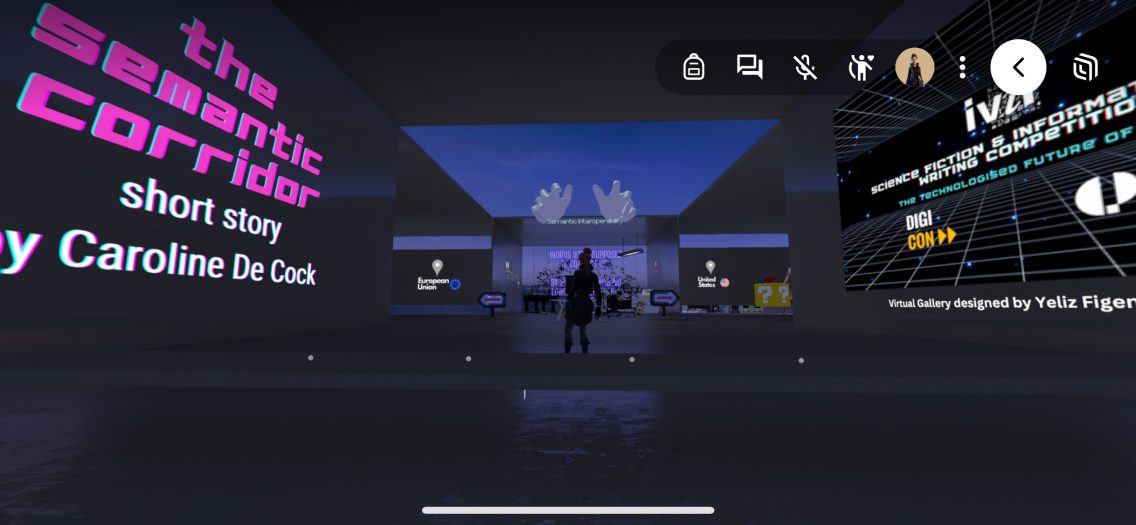
We were equally lucky to have Caroline De Cock, a Brussels native, present her story at the Award Ceremony. Caroline, rather than through words, tends to think through images. Which is why, even before the virtual gallery above, there already was a comic version of her story, here. Despite this being the first story she ever wrote – not counting the ones from high school – she had the audience in the palm of her hand, raising a lot of laughter from the cinema chairs.
Most Haunting Story
Clerk 9
by Alberto Rinaldi
All jury members were united in their appraisal of the logical coherences of the story that followed a clear theme and built suspense. A common denominator appraised by the juries was the powerful theme of resistance in a future where human rights and law is increasingly under attack.
Or, as one jury member said: “The revolutionary spirit is felt”, while another explained: “I liked the theme of this story very much. The way that the original clerk signals resistance and then the clerk who finds the file, understands what Clerk 9 has done, and finds a way to complete the mission, is powerful”.
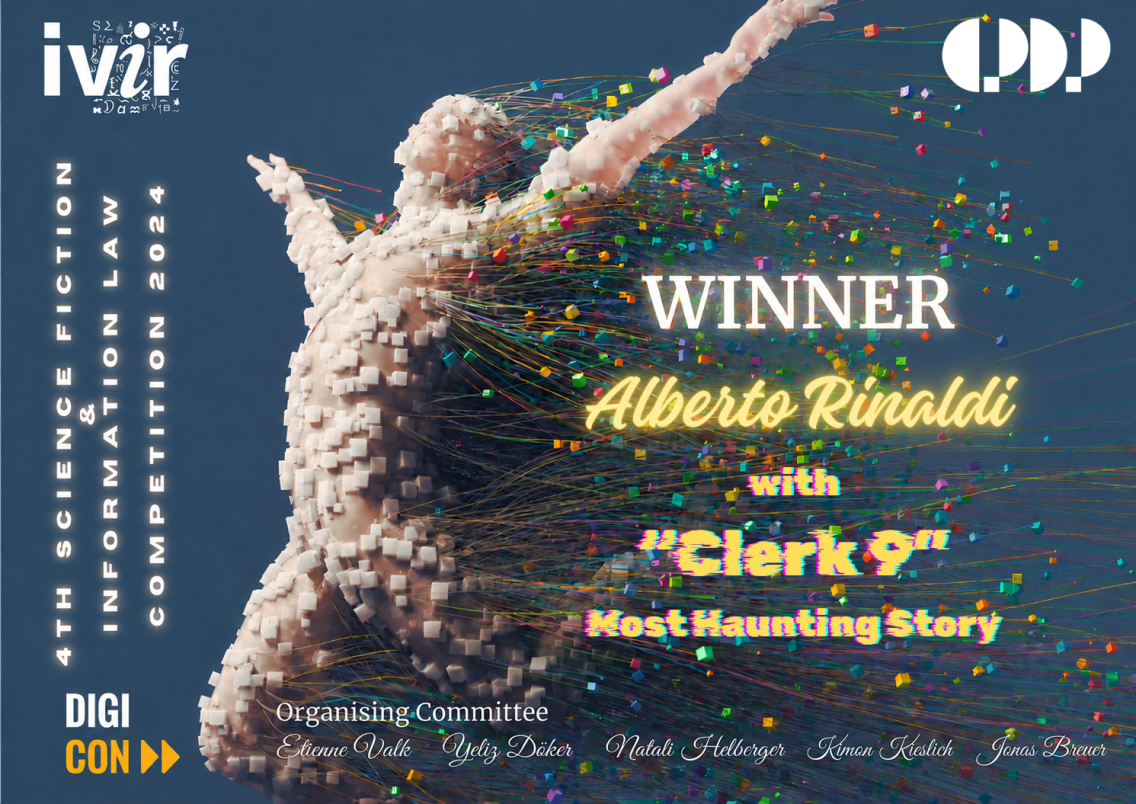
The juries also praised the writing style of the story, describing it as “very focused and profound in its simplicity”, “great word building” with a “rounded storyline” and “lots of imagination” and “logical coherent”. Or, as one jury member said, “simply haunting”.
That is why Clerk 9 is awarded “Most Haunting Story”.
The organising institutions IViR, DigiCon and CPDP would like to once again congratulate the winners on their exceptional contributions. This event was funded by the Institute for Information Law (IViR).
Also, a big thank you to this year’s jury members Prof. Anna Gerbrandy, Prof. Christine Corcos, Prof. Lilian Edwards, Dr. Mykola Makhortykh, and Patricia Lustig.
Brace yourselves for the competition’s next edition!
The 4th Edition’s Organising Committee (Natali Helberger (IViR), Etienne Valk (IViR & DigiCon), Yeliz Figen Döker (DigiCon), Kimon Kieslich (AI, Media & Democracy Lab), and Jonas Breuer (CPDP)).
- For accessing the gallery, you have to create an account on the platform, unfortunately. ↩︎